• Skip to primary navigation
  • Skip to main content
  • Skip to primary sidebar
  • Skip to footer

Sheila Cantonwine

  • Home
  • About Me
  • Blog
    • 4th Grade Math
    • 5th Grade Math
    • 6th Grade Math
    • Back to School
    • Boom Cards
    • Classroom Organization
    • Digital Resources
    • Holidays
    • Math Test Prep & Review
    • Summer Math
    • Teacher Self Care
  • Shop
    • Teachers Pay Teachers
    • Amazon
    • Boom Learning
  • Affiliates
  • Contact
  • Navigation Menu: Social Icons

    • Email
    • Facebook
    • Instagram
    • Pinterest

5th Grade Math

Valentine’s Day Math Activities for Upper Elementary

February 2, 2022 by Sheila Cantonwine

This post contains affiliate links. As an Amazon Associate, I earn from qualifying purchases and use those earnings to help defray the cost of running my website.
Valentine's Day Resources for Upper Elementary Math

Finding engaging Valentine’s Day activities for your upper elementary math classroom can be a challenge. Students are young enough that they still want to celebrate Valentine’s Day in their classrooms. They’re sensitive to activities that are geared more toward younger students.

Plus, with the holiday in February, you need to make sure any activities have lots of math practice for your students. With end-of-year testing right around the corner, every day counts in covering new material or reviewing your math curriculum.

Here are some fun Valentine’s Day activities that will make the holiday go smoother in your upper elementary math classroom.

1. Valentine’s Day Activities Worksheets for Upper Elementary Math
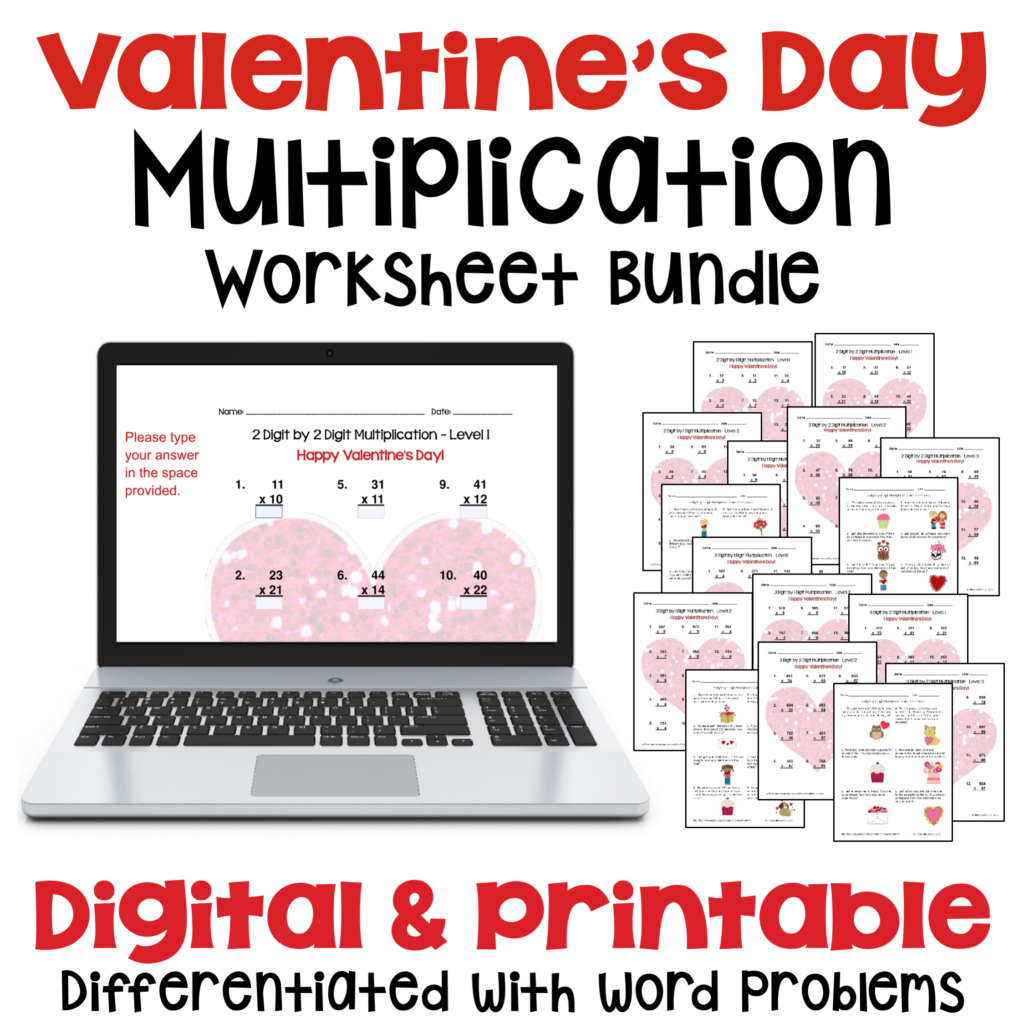
Valentine's Day Multiplication Worksheet Bundle

Worksheets are great because you can use them in so many different ways: morning work, math centers, classwork, homework, early finishers, or sub plans.

Math centers are always fun because the students get to move around the room to different centers to complete different tasks.  Using differentiated worksheets is helpful because students can start with the easiest (level 1). After they gain confidence they can then work their way through more challenging questions (levels 2 and 3). Finally, they can finish with the most challenging word problems. 

Using a Valentine’s Day theme will get them in a festive mood and make the math review more interesting.  Math centers with worksheets are also great for sub plans if you know you will have to miss some days of school in February. You might also be interested in Valentine’s Day Decimal Worksheet Bundle.

2. Valentine’s Day Task Cards
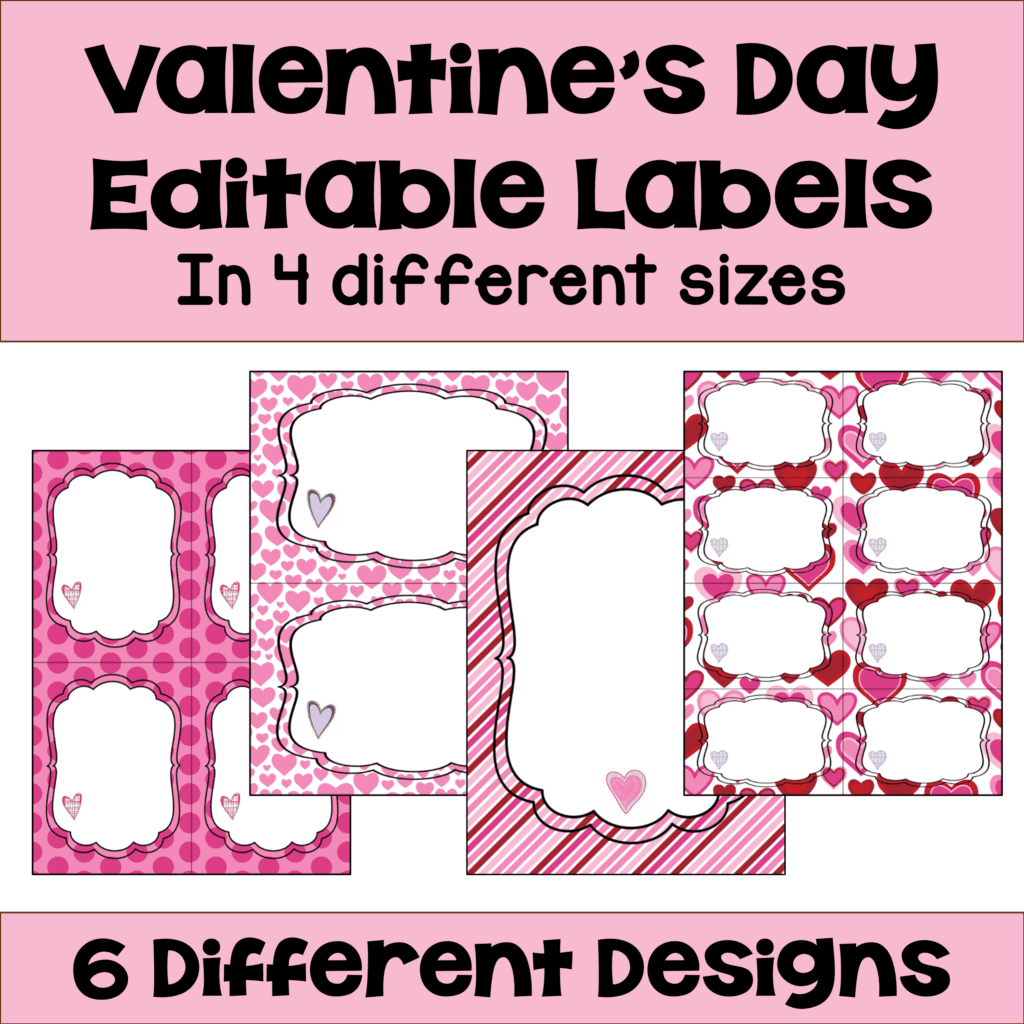
Valentine's Day Editable Labels

Use these Valentine’s Day Editable Labels to create your own task cards for your students. There are 6 different designs and 4 different sizes so there are a lot of options for you. Either type or handwrite the questions for your students. Or, for an extra challenge, ask your students to write the questions.

Task cards are fun because students work on one question at a time while moving around the room.  You can have them work individually or with partners. Use task cards as a “Roam the Room” activity where you place task cards all over the room and they have to search for each question before they answer it.  Or, you can play scoot where you place a task card on each student desk and students “scoot” from one desk to the next as they answer the question.  Finally, you could set up centers where students answer 3-5 task cards at each center.  There are so many options with task cards.

3. Math Games Similar to Jeopardy for Valentine’s Day
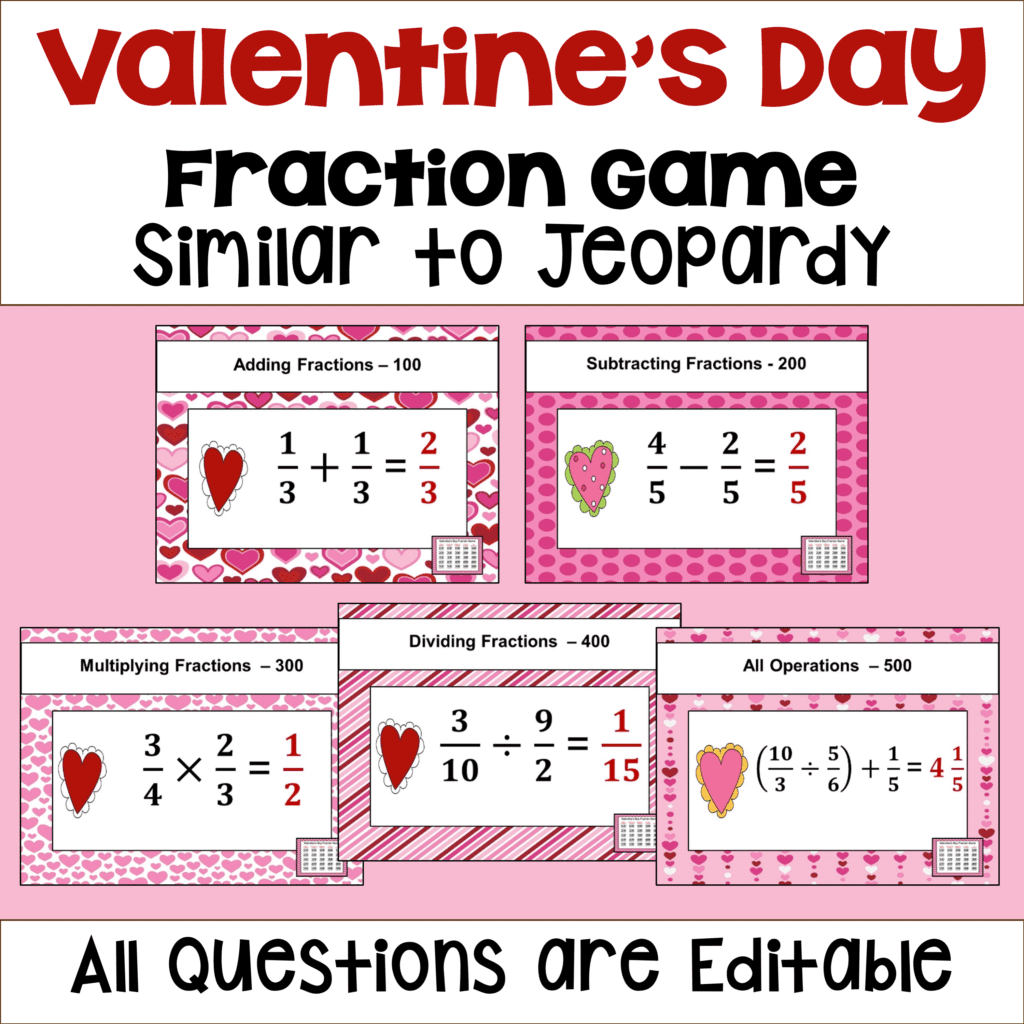
Valentine's Day Fraction Game Similar to Jeopardy

My classes always enjoy a fun game of Jeopardy.  They get to work in teams which takes the pressure off students who may be struggling with a particular math topic (fractions, multiplication, integers, or decimals). 

They learn how to work together and they usually have so much fun that they forget they’re practicing math.  If you use an editable game like this one, you can play the game on day 1 then ask teams to write new questions to create a second game for day 2. 

Find some easy prizes like mini erasers, Homework passes, or Valentine’s Day chocolate for the team that wins and they have additional motivation.

4. Self-Correcting Boom Cards
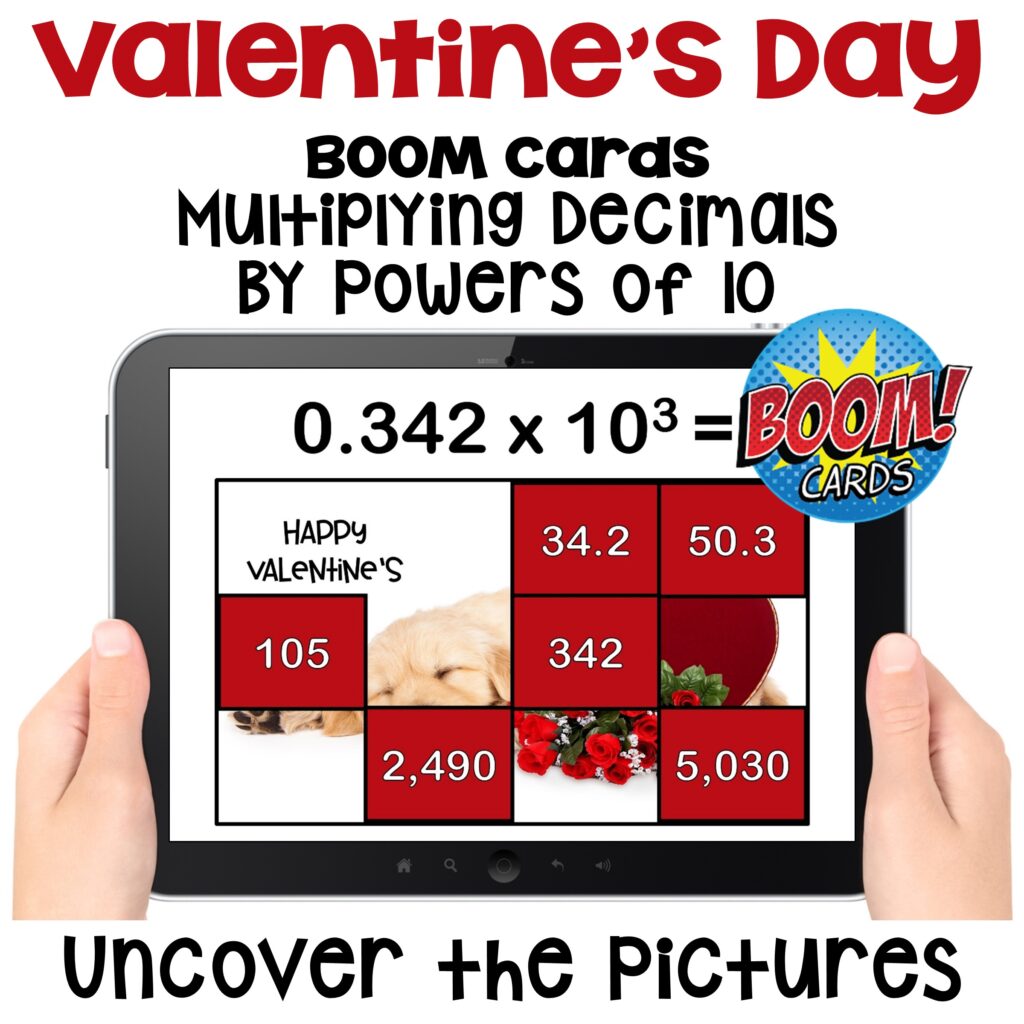
Valentine's Day Math Boom Cards

Boom cards are great if your students need a little downtime after other Valentine’s Day activities.  They are a quiet activity that can be used individually or with a partner.  They are also great to use either in person or as a remote activity.

Students work at their own pace and all the questions are self-correcting so the students can immediately learn from their mistakes.  Students also love how interactive the questions are. For example, with these uncover the picture Boom cards, students tap or click on one of the red rectangles to answer the questions. As they answer correctly, they uncover a Valentine’s Day themed image that is hidden underneath. This deck has 2 different images to uncover for lots of fun practice.

You might be interested in other Valentine’s Day themed Boom Cards for your classroom.

Boom cards are also a big time-saver for teachers because the grading is automatically done for you and you can track student data. It’s also a great way for students to use technology in the classroom.

If you’ve never tried Boom cards before, download some free boom cards first to see how they would work in your classroom. You can also make your own Boom cards to use in your classroom, sell on TpT and also sell on the Boom Learning website.
I hope you found these suggestions helpful as you plan your Valentine’s Day activities for your upper elementary math classroom.

Looking for more fun activities? Check out all my Valentine’s Day math activities in my TpT store.

Filed Under: 4th Grade Math, 5th Grade Math, 6th Grade Math, Holidays Tagged With: Valentine's Day 4th Grade, Valentine's Day 5th Grade, Valentine's Day Activities, Valentine's Day Math, Valentine's Day Upper Elementary

4 Fun Ways to Test Prep and Review for 5th Grade Math

January 24, 2022 by Sheila Cantonwine

4 Fun Ways to Test Prep and Review for 5th Grade Math

5th Grade Math Review while preparing for End of Year exams can be super stressful for students and teachers too.  Especially with all the craziness of the pandemic these last couple of years.

Ideally, you want to cover all the topics before the exam while making sure the students feel confident and not overwhelmed.  From the student’s perspective, you want to make the review engaging and fun.  Using the same materials over and over again is tiresome for students and can be very stressful if they struggle with taking standardized tests. 

Trying different types of review will make test prep fun for them and you’ll gain valuable knowledge on what information they are confident with and what needs to be reviewed. Here are 4 Fun Ways to Test Prep for 5th Grade Math. 

1. PLAY AN INTERACTIVE GAME FOR 5TH GRADE MATH REVIEW

5th Grade Math Games Similar to Jeopardy

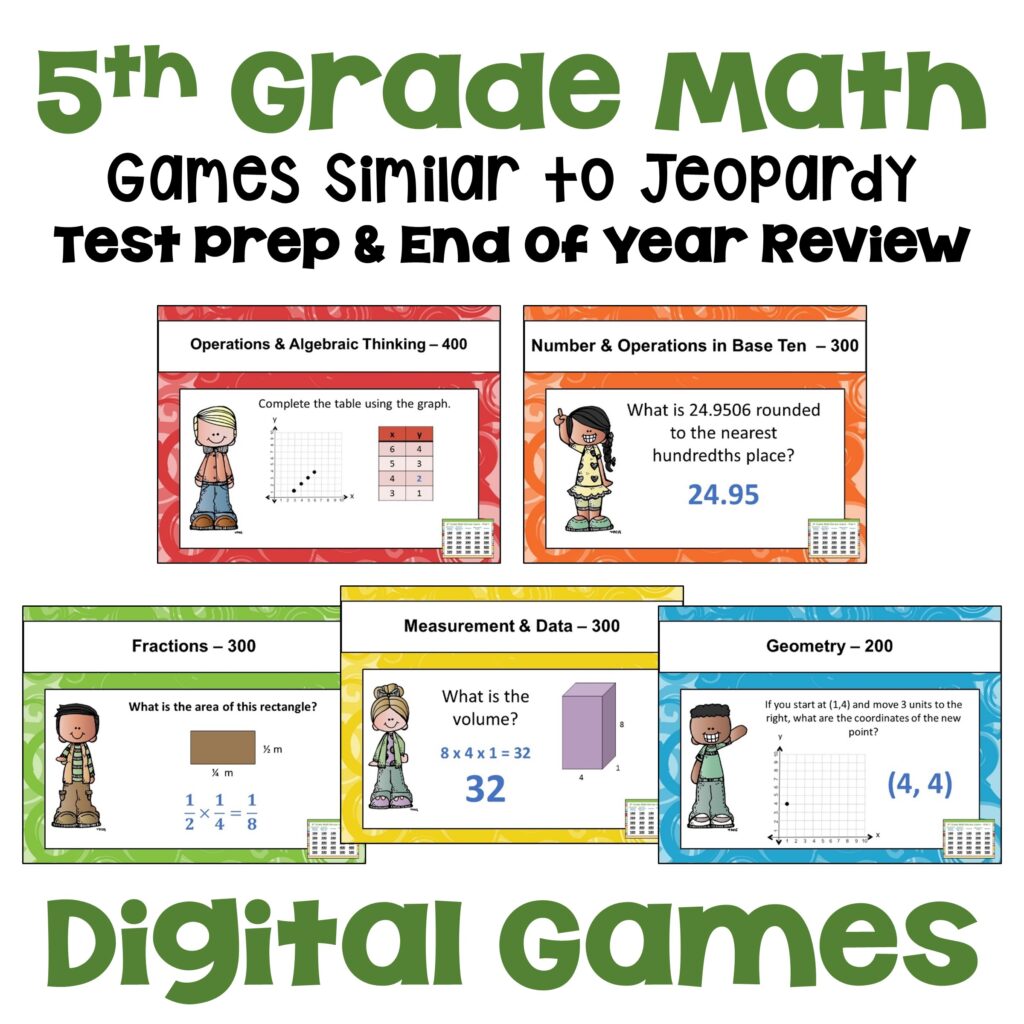
Students love playing games and these are perfect for 5th Grade Math Review. They are a fun way to review and students can also learn to collaborate and play well with other students. Digital games are particularly fun because they’re interactive.  One example is this PowerPoint game that is played similar to Jeopardy.  Students form teams, nominate a team captain, then work through all 50 questions to review all the topics in 5thgrade math.  Each question has the common core alignment so teachers can take note of which questions might cause students to struggle.

The questions for this game are also editable which means you can use them for additional activities.  After playing the game once, many teachers assign questions to different teams, then create a totally new set of questions for a totally new game.  Students enjoy writing the questions and it’s a great way to extend the review to multiple days.

2. USE PRINTABLE TASK CARDS FOR EARLY FINISHERS, SCOOT, OR AROUND THE ROOM

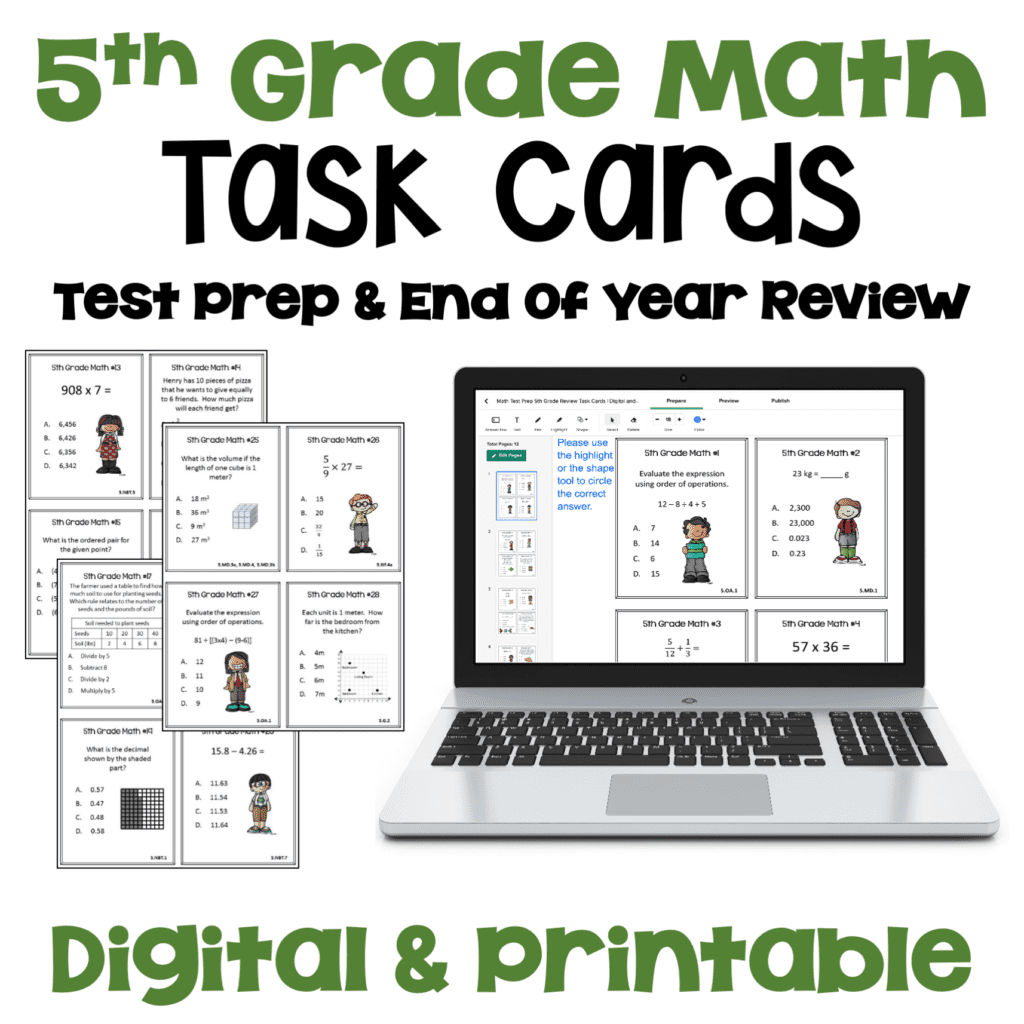
5th Grade Math Task Cards

Printable task cards are a great activity for 5th Grade Math Review. They’re interactive and students can either work individually or with a partner.  Some teachers print these at the beginning of the year then use them for early finishers throughout the school year.

Scoot and Around the Room are fun because students get to move around the classroom a little.  With scoot, you would put 1 or 2 task cards on each desk then students scoot from desk to desk to answer the questions.  Around the room is similar except you place the task cards all over your classroom.  Walls, the floor, the door, windows, all make great places to tape the task cards.  Then students have to find the card, like a scavenger hunt, before they can answer the questions.

I usually laminate the cards so they last a little longer.  Students record their answers on recording sheets and it’s really easy to grade with the answer key.  You can even have students grade their own recording sheets then go back and try the questions they missed again.

3. SELF-CORRECTING DIGITAL TASK CARDS ON BOOM LEARNING FOR 5TH GRADE MATH REVIEW

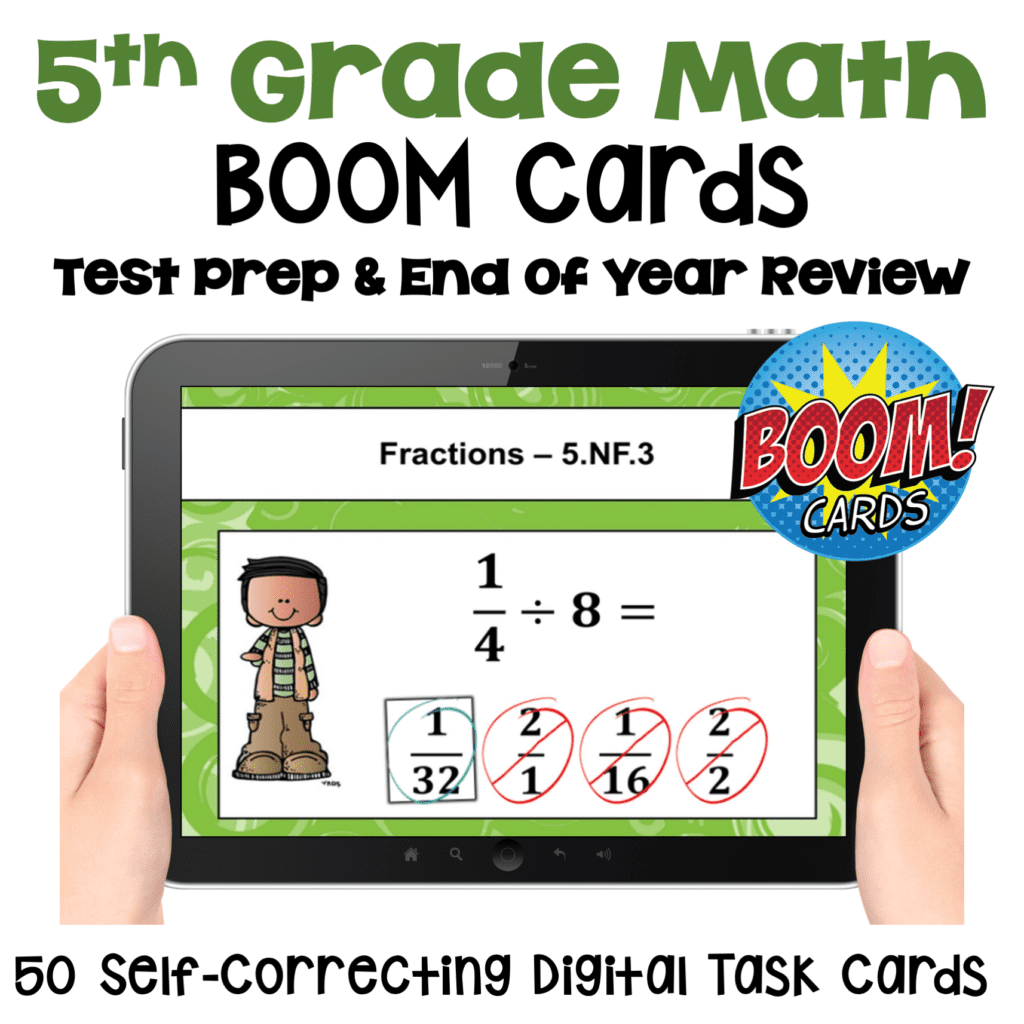
5th Grade Math Boom Cards for Test Prep and End of Year Review

I love using digital task cards because they’re interactive, self-paced, and can even track student data. These are probably the easiest for teachers to use because everything is digital which means no printing, laminating, cutting, or storing the task cards.  Plus, you can either play them in person in the classroom or as a remote learning activity which makes them really versatile.

With certain memberships on Boom Learning, you can also track student data.  This makes it super easy to see which questions are most missed by your students so you can review and reteach before the big test.

If you are new to digital task cards or want more information about how to use Boom cards in your classroom, check out this article on 6 Reasons to Use Boom Cards in Your Classroom. You can also learn how to make your own Boom cards to sell on Teachers Pay Teachers and the Boom Learning website.

4. PRINTABLE WORKSHEETS SIMILAR TO A PRACTICE TEST

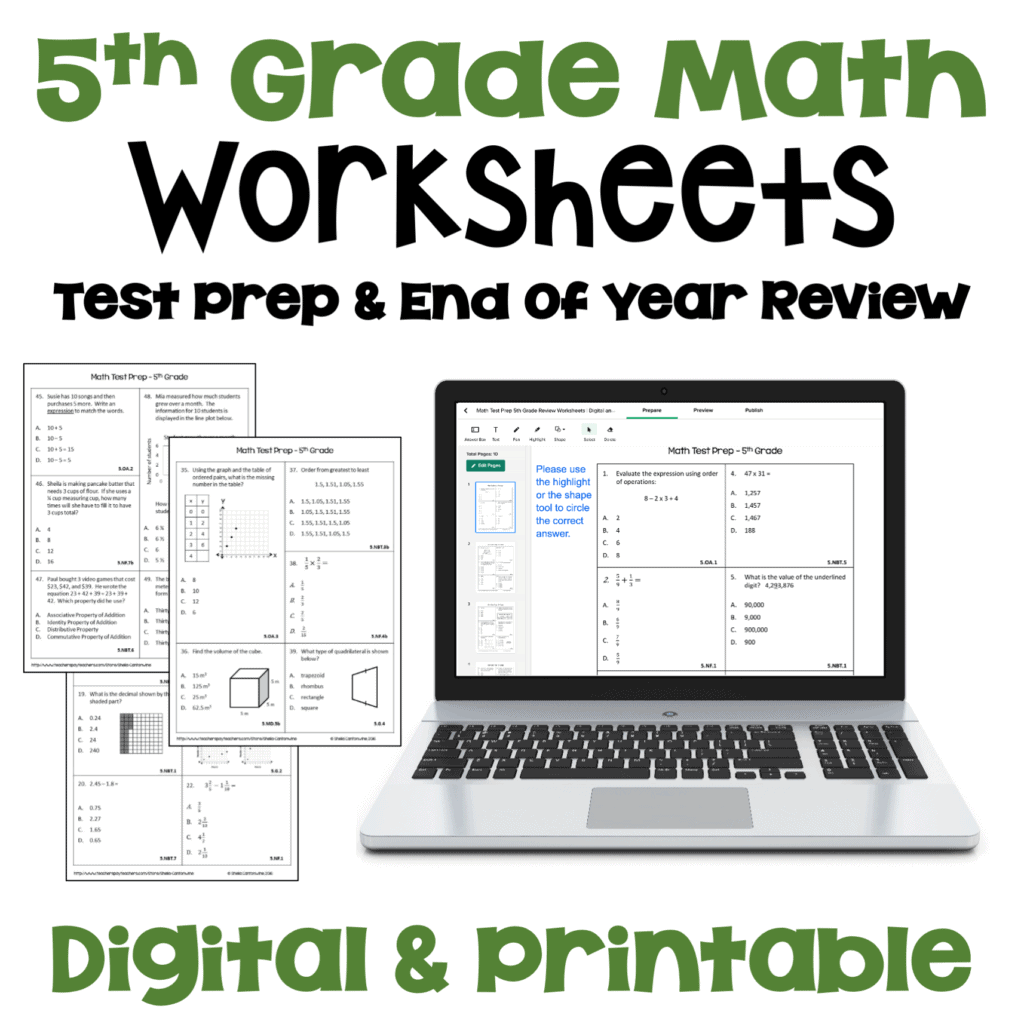
5th Grade Math Worksheets for Test Prep and End of Year Review

Worksheets with multiple-choice questions are always valuable because they are most similar to the test that your students will most likely take for their end-of-year exam. Worksheets give them practice with multiple-choice questions, they cover all the topics for 5th-grade math and also have the common core alignment for each question. 

I have found that this review can be intimidating for students sometimes so it might be best to break this up with a page or two per day rather than the entire set of worksheets.

If you are a 6th grade math teacher, this would also be a great pre-test for your students at the beginning of the school ear to see how much information they retained over the summer break.


SAVE WITH THE BUNDLE FOR 5TH GRADE MATH REVIEW

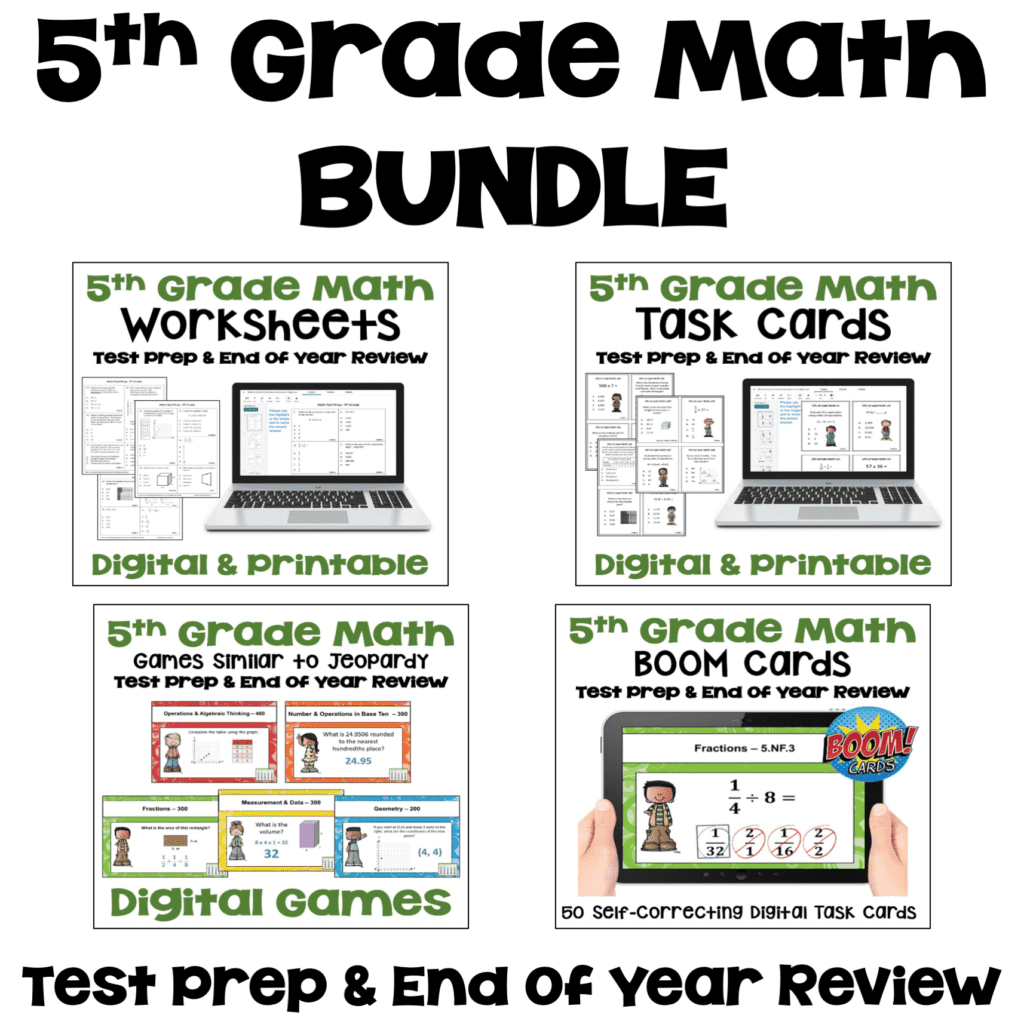
5th Grade Math Review and Test Prep Bundle

I hope you find all of these suggestions helpful for your math test prep in your 5th grade class.  If you are interested in using all four types of review, try the Math Test Prep Bundle for 5th Grade Math Review. 

It has a couple of weeks worth of review materials with completely different questions to keep your students engaged in the test prep season.

Filed Under: 5th Grade Math, Digital Resources, Test Prep and Review Tagged With: 5th Grade Math, 5th Grade Math Review, 5th Grade Math Test Prep

Thanksgiving Activities for Upper Elementary Math

November 4, 2019 by Sheila Cantonwine 1 Comment

Thanksgiving Activities for Upper Elementary Math

Engaging Thanksgiving activities for your upper elementary math classroom can be challenging. First of all, the week is awkward, with most schools taking Wednesday through Friday off for the holiday. That means you have to find something that will be beneficial with one or two days of instruction.  Second, some of your students may be missing school to travel. This means it would be a good idea not to introduce new material making review your best bet. Finally, students are distracted by the short week, so it’s a challenge to keep them focused.

Here are some fun Thanksgiving activities that will make those days go smoother in your upper elementary math classroom.

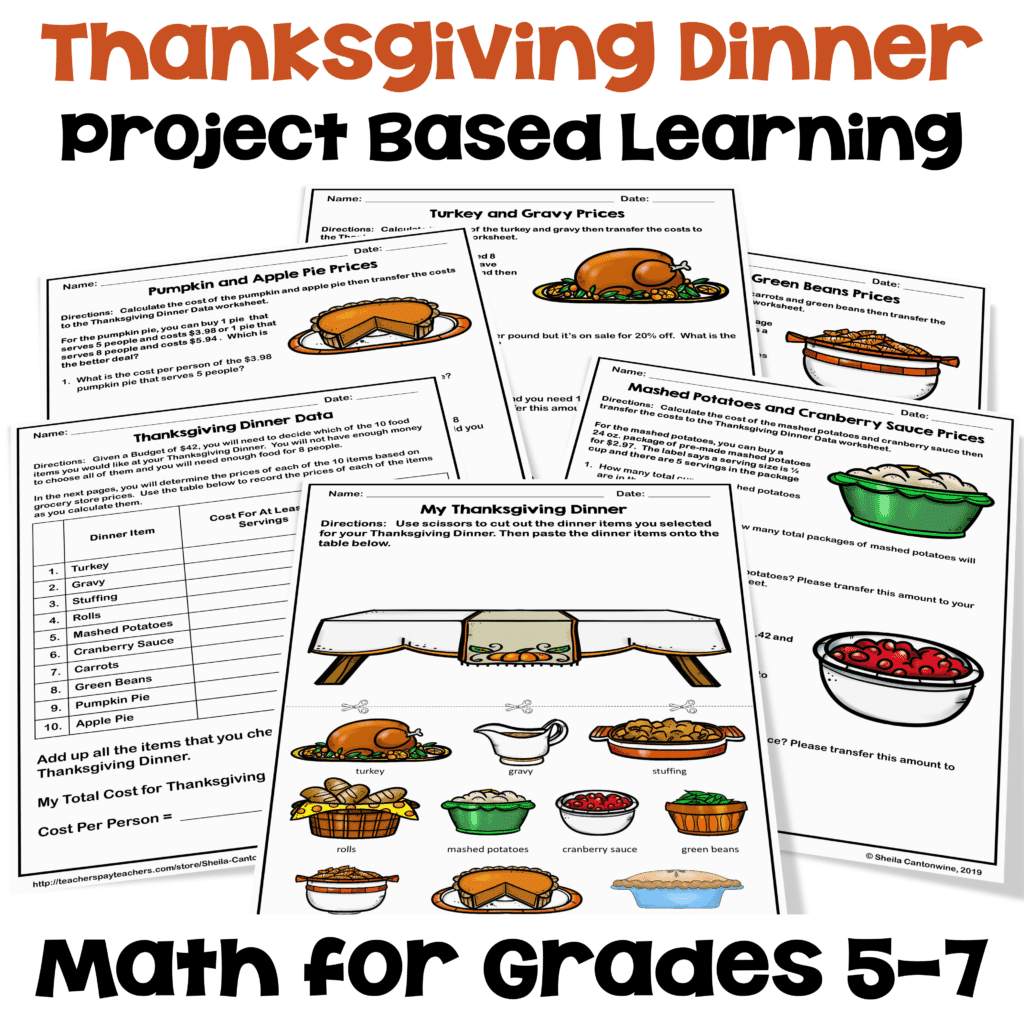
1. Project-Based Learning

Thanksgiving Dinner Project Based Learning

Project based learning is great because it satisfies all three criteria for an engaging Thanksgiving activity.  Most projects have 2-3 days’ worth of work, and you can even taper that depending on the activities that you want to use with your students.  Use some or all of the activities depending on how much time you have. Also, choose math topics your students need to review, like multiplication, decimals, or fractions, so students who are out of school won’t miss learning new material. 

This Thanksgiving project has students planning a Thanksgiving dinner based on a given budget. They get to pick their favorite side dishes and create their own Thanksgiving Dinner. Having something holiday-themed will keep them engaged and focused. 

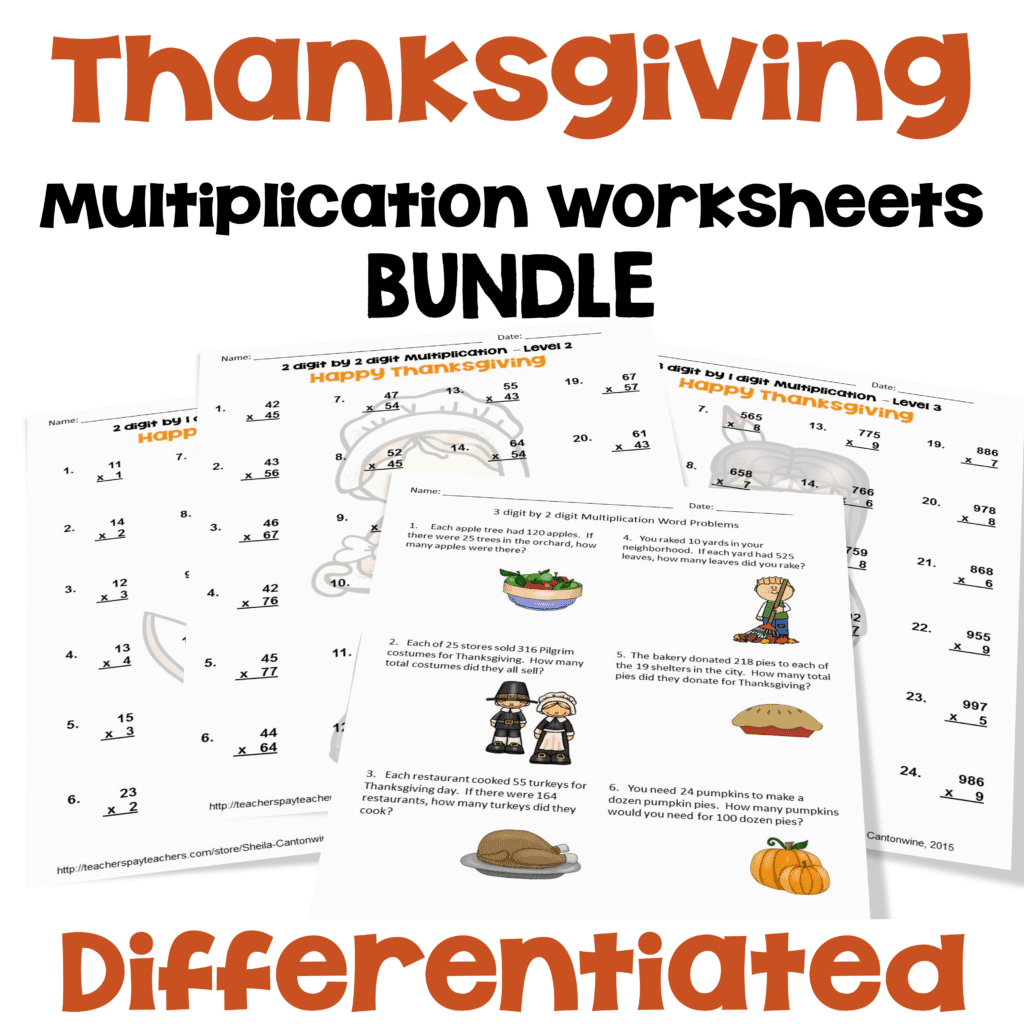
2. Math Centers with Worksheets Thanksgiving Activities for Upper Elementary Math

Thanksgiving Multiplication Worksheets

Math centers are always fun because the students get to move around the room to different centers to complete different tasks.  Using differentiated worksheets is helpful because students can start with the easiest (level 1), then work their way through more challenging questions (levels 2 and 3) then finish with the most challenging word problems.  Using a Thanksgiving theme will get them in the holiday spirit and make the math review more interesting.  Math centers with worksheets are also great for sub plans if you know you will have to miss those days leading up to Thanksgiving break.

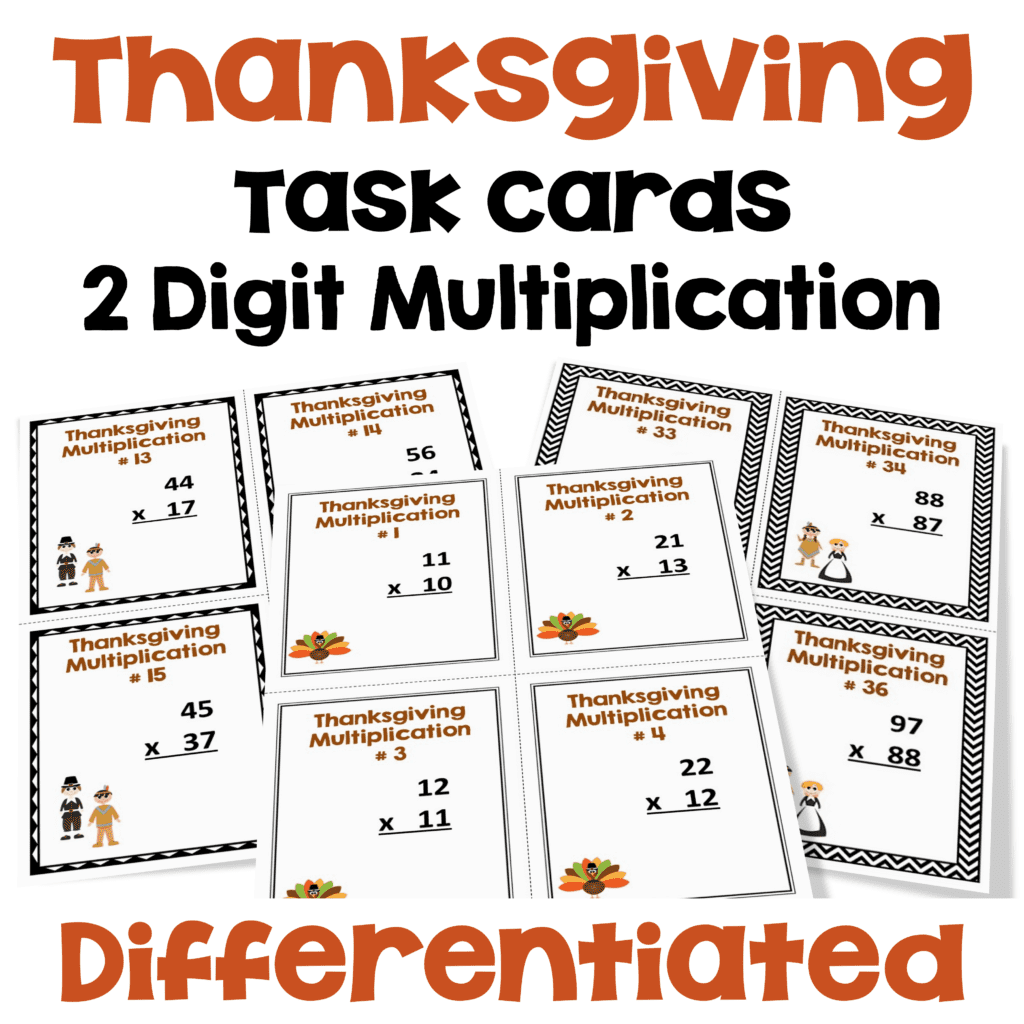
3. Math Centers with Task Cards

Thanksgiving Activities for Upper Elementary Math

Task cards are fun because students work on one question at a time while moving around the room.  You can have them work individually or with partners. Use task cards as a “Roam the Room” activity where you place task cards all over the room, and they have to search for each question before they answer it.  Or, you can play scoot, where you place a task card on each student’s desk, and students “scoot” from one desk to the next as they answer the question.  Finally, you could set up centers where students answer 3-5 task cards at each center.  There are so many options with task cards.

If you want to create your own task cards OR have your students make task cards, you could use these Thanksgiving Editable Labels to create your own custom task cards for your class.

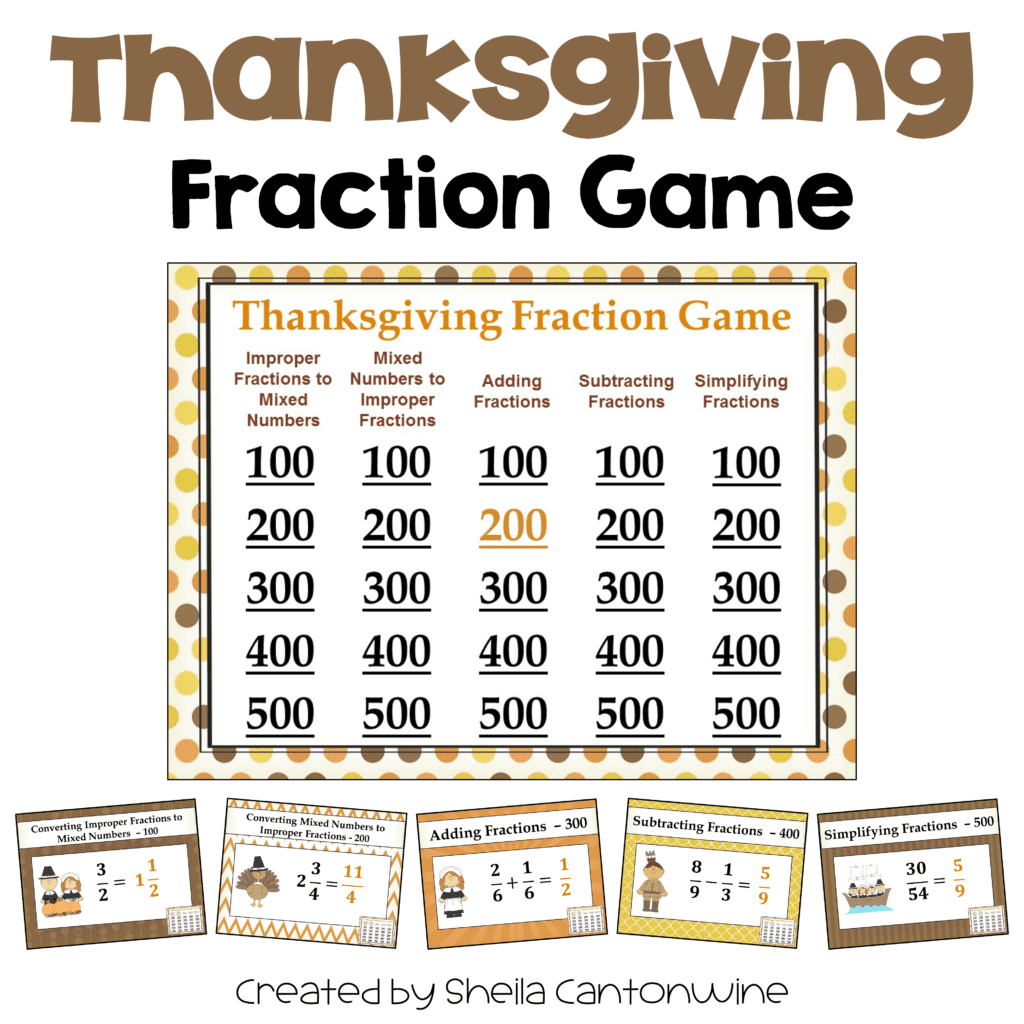
4. Digital Games with the Whole Class Thanksgiving Activities for Upper Elementary Math

Thanksgiving Activities for Upper Elementary Math

My classes always enjoyed a good game of Jeopardy.  They get to work in teams which takes some of the pressure off for kids who may be over-excited or worn out with the upcoming holiday.  They learn how to work together, and they usually have so much fun that they forget they’re practicing math.  If you use an editable game like this one, you can play the game on day 1 and then ask teams to write new questions to create a second game for day 2.  Find some easy prizes like mini erasers for the team that wins, and they have additional motivation.

5. Digital Resources for Individuals

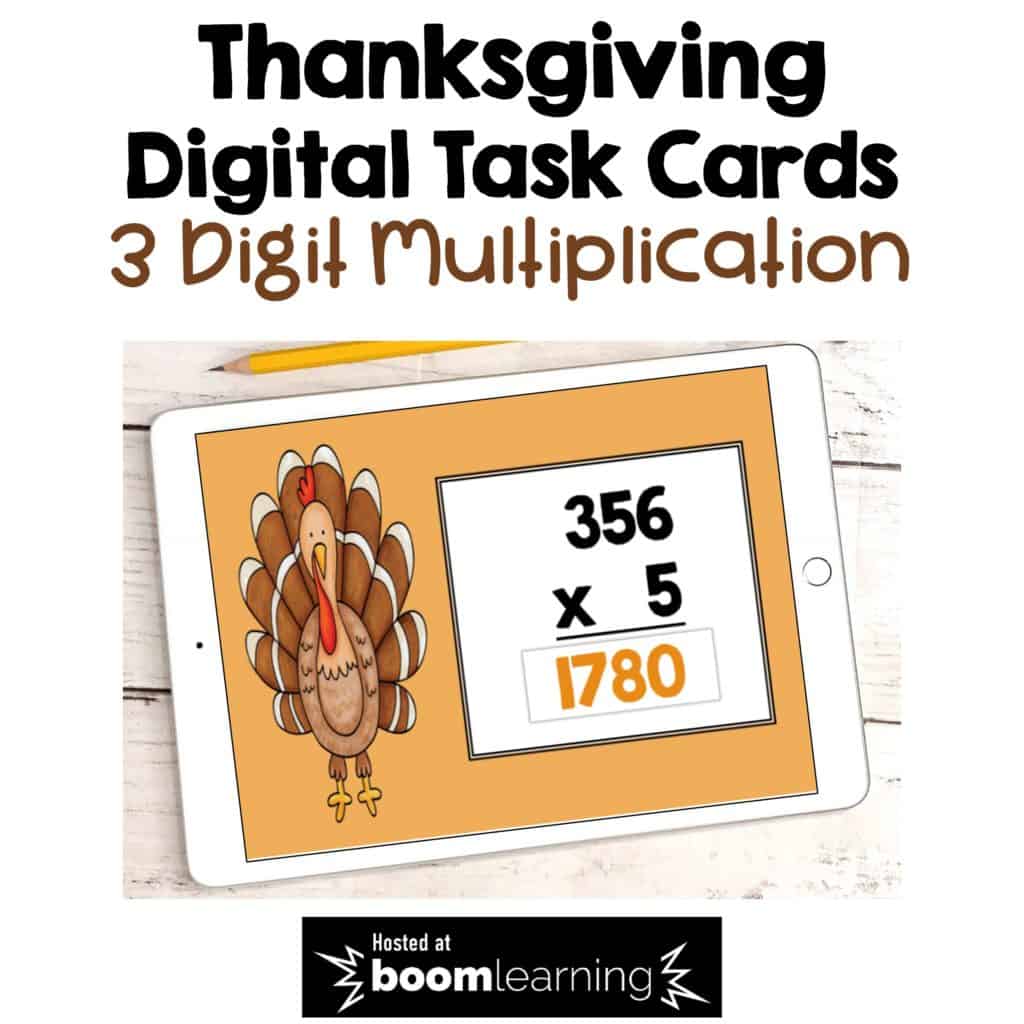
Thanksgiving BOOM cards for 3 digit multiplication

Digital resources like Boom cards are great if your students need a little downtime after other Thanksgiving activities.  It’s a quiet activity that can be used individually or with a partner.  Students work at their own pace, and all the questions are self-correcting, so they can immediately learn from their mistakes.  Students also love how interactive the questions are. It’s also a big time saver for teachers because the grading is automatically done for you, and you can track student data. And it’s a great way for students to use technology in the classroom.

If you’ve never tried Boom cards before, download some free boom cards first to see how they would work in your classroom. You can also make your own Boom cards to use in your classroom, sell on TpT and also sell on the Boom Learning website.
I hope you found these suggestions helpful as you plan your Thanksgiving activities for your upper elementary math classroom.

Click here to check out ALL my Thanksgiving resources for upper elementary math.

Filed Under: 4th Grade Math, 5th Grade Math, 6th Grade Math, Holidays Tagged With: Thanksgiving 4th Grade, Thanksgiving 5th Grade, Thanksgiving 6th Grade, Thanksgiving Activities, Thanksgiving Math, Thanksgiving Math Centers, Thanksgiving Project Based Learning

Using Grill and Drill to Teach Basic Math Operations

October 18, 2019 by Sheila Cantonwine 2 Comments

This post contains affiliate links.  As an Amazon Associate I earn from qualifying purchases.

What exactly is Grill and Drill?

Using Grill and Drill to Teach Basic Math Operations

Grill and Drill is a term that is used when students are asked to do the same task over and over again.  It is persistent and repetitive exercise with the goal of learning something.  Grill and drill to teach basic math operations like addition, subtraction, multiplication, and division means practicing many times throughout different grade levels and throughout the entire school year.  In this way,  students will gain confidence and proficiency.

There are many reasons why I support using Grill and Drill to teach basic math operations.  As a middle school math teacher, I often saw students who struggled with math.  As I spent more time with them, I realized that they weren’t struggling with the concepts, they were struggling with basic math operations.  Addition and subtraction were a challenge but they really struggled with multiplication and division.

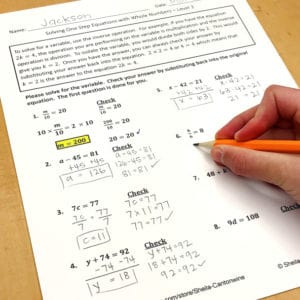
Solving one step equations

Take variables for example.  Most students understood the meaning of a variable and could see how you would solve for variables.  It’s the basic operations that always hung them up.

Let’s say you had an equation, 8x = 56.  They understood that to solve for the variable they had to divide both sides of the equation by 8.  What they didn’t know was that 56 divided by 8 was 7!  I would give them a similar problem, 2x = 4 and right away they knew the answer was 2.  But they struggled with the bigger numbers.  And they were in middle school!

The same thing would happen with integers.  Students were able to understand the concept of negative numbers but they really struggled when they had to do the actual math.  If they had a problem like +19 + – 25 they knew that the answer was negative but they would struggle with the actual subtraction.


Why do students struggle with the basic operations?

I think it has to do with the way that math is taught in the lower grades.  Not enough practice is given with basic operations so when they progress into more difficult math in the upper grades, they struggle.

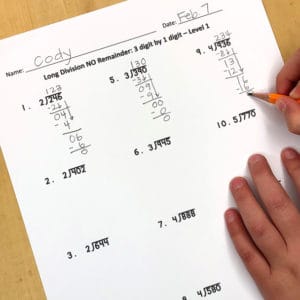
3 digit by 1 digit long division worksheets

When I was growing up, my teachers always used grill and drill exercises.  I remember doing endless worksheets on addition, subtraction, multiplication, and division when I was in elementary school.  While they weren’t the most fun, they helped me learn my basic math operations.  When I got into algebra and higher level math, I knew my basic operations very well and hardly ever struggled.

I know there are new ways to teach basic operations with conceptual learning and understanding and I’m all for that.  Teach these concepts the best way that you know how and the best way that students learn.  But once they understand the concepts, that’s where grill and drill comes in.  Practice, practice, and more practice until they know addition, subtraction, multiplication, and division like the back of their hand.  They shouldn’t have to think about what 81 ÷ 9 is, they should just know it.

Practice Makes Perfect

Think about athletes and how they perform.  They spend years learning the basics like how to dribble for basketball, how to skate for hockey, how to perfect their swing in golf or how to kick a hard shot on goal for soccer.  Then they practice over and over again until it is second nature.  They don’t have to think about it.  After all the hours of practice, their body just knows what to do.

Musician

Think about elite musicians.  They aren’t great musicians because they practiced a song once.  They’re great because they practice over and over again.  They spend countless hours with their instruments before they are able to perform effortlessly.

So why are we not doing this when we teach kid basic math operations? How can we expect them to feel confident with math when doing the simple operations are such a struggle for them?  What are some ideas for making “grill and drill” easier for students and teachers.

Spiraling Helps with Grill and Drill to Teach Basic Math Operations

One thing that might help is spiraling topics throughout the school year.  For example, with multiplication, you could use different resources throughout the school year so students don’t feel like it is tedious work.  Worksheets, task cards, games, math centers, holiday resources, and digital task cards are all great ways to practice the same skill but with a different delivery.

Timed Tests

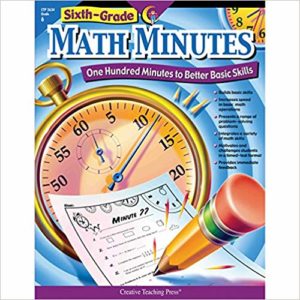
6th Grade Math Minutes

I also love the idea of doing timed tests.  When students are in lower grades, it’s a great way for them to become comfortable with the basic operations. Even in middle school you could do something like math minutes (affiliate link).  I used to have math minutes once per week with my students.  They had 10 math questions to complete in 1 minute.  Just for fun, I’d do it with them and they were always shocked at how quickly I could complete the questions.  I’d keep track of what their scores were then give prizes at the end of each quarter.  It made math fun and it motivated them to get stronger in their basic operations.

Differentiated Resources Help with Grill and Drill to Teach Basic Math Operations

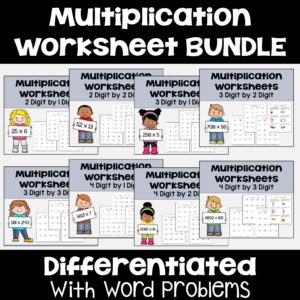
Multiplication Worksheet Bundle

I am a huge proponent of differentiated resources and most of my math resources have 3 different levels.  Students can start at the lowest level and gain confidence as they move through more challenging levels.  It’s a great way for students to get lots of practice without getting overwhelmed.

You could also use differentiated resources by student.  If you have a student who is BELOW grade level then you could start them at level 1.  Students who are AT grade level could work on level 2.  Students who are ABOVE grade level could complete level 3.  That way, all students could work at the level that they are most comfortable with.

What’s the bottom line?

Students need to practice the basic operations more regularly when they are in the upper elementary grades.  I have found that if they’re not able to do that they will struggle with the more complicated math concepts like fractions, decimals, integers, and equations.

The more that students practice these skills the easier it will be for them to understand more challenging math topics.

Filed Under: 4th Grade Math, 5th Grade Math, 6th Grade Math Tagged With: Addition, Division, Grill and Drill, Multiplication, Subtraction

5 Ways of Practicing Multi-Digit Multiplication

September 10, 2019 by Sheila Cantonwine 3 Comments

Why should students practice multiplication?

5 Ways to Practice Multi Digit MultiplicationPracticing multi digit multiplication can be a challenge for teachers and students alike.  Teachers want to make sure they give students enough practice but students can become bored when using the same resources over and over again.
I believe that practicing math makes students successful.  This is especially true when it comes to the basic operations like addition, subtraction, multiplication, and long division.

Some may call it grill and drill but I like to explain it to my students this way.  Think about your favorite athlete (or dancer, or musician, or entertainer).  I love soccer so let’s use that as an example.  How do you think your favorite soccer player got so good at what they do?  Practice.  They take thousands of penalty kicks and do countless drills before you see them in the game.  It’s not just luck.  It’s hard work and lots of practice that makes them be able to effortlessly score goals and weave in and out of defenders.

The same is true with math.  The more you practice, the easier it gets.  Here are 5 different ways that you can practice multi digit multiplication with your students.

1. Differentiated Worksheets

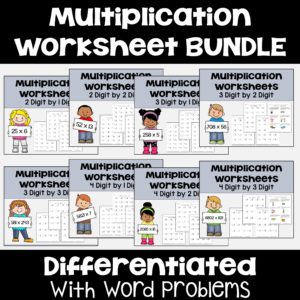
Multiplication Worksheet BUNDLEPracticing Multi Digit Multiplication with Worksheets is very common but putting a twist on them by adding differentiation or word problems can make a big difference. 

Worksheets are great for homework, morning work, classwork, and math centers.  They are great to spiral throughout the whole year.  If you use differentiated worksheets, students start with easier questions then move to more challenging ones as they gain confidence.  Differentiation is a great way to reach ALL your students.

For example, these worksheets have 4 different levels for each of the topics.  Level 1 is the easiest, Level 2 is a little more difficult, and Level 3 is the most challenging.  Once students are confident with these questions they can move to word problems for additional practice.

2.  Practicing Multi Digit Multiplication with Digital Task Cards

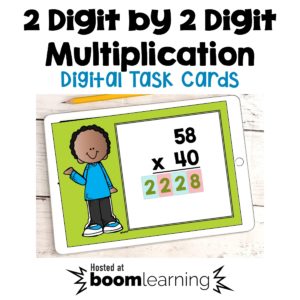
Digital task cards are great because they are self paced.  Students can work as slowly as they need to without worrying about holding the rest of the class back.  Digital task cards are also self correcting so students have immediate feedback on whether the question is correct or incorrect.  Finally, digital task cards are interactive making learning more fun.

2 Digit by 2 Digit Multiplication BOOM CardsWith these digital task cards on BOOM Learning, students can practice their 2 digit by 2 digit multiplication.  In the image shown to the right, you can see that the student got 2 of the 4 digits for the answer correct.  They can then go back, figure out what they did wrong, then come back and type the correct answer.

It’s helpful to have students work the problems out on paper before they type their answers for these digital task cards.

If you’re new to BOOM cards, check out this post on 6 Reasons to Use Boom Cards in Your Classroom.

3. Printable Differentiated Task Cards

Printable task cards are great to have in your classroom and for playing games like Scoot or Around the Room.  They are also wonderful for math centers too.  Students love the chance to get out of their seats and move around the room.

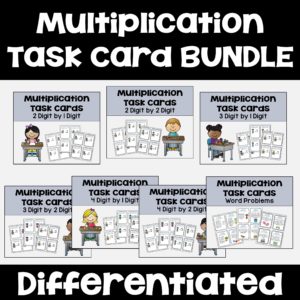
Multiplication Task Card BundleWith these differentiated task cards, each of the 3 levels has a different border so you can easily see which level the students are working on.  This is great if you want to differentiate for each student.  Let’s say you have only 30 minutes for this practice.  You can have students that are below grade level practice the level 1 cards (cards 1-12).  The students that are at grade level could practice the level 2 cards (cards 13-24).  Students that are above grade level could practice the level 3 cards (cards 25-36).

4. Practicing Multi Digit Multiplication with Games

Students love games!  The goal is for them to have so much fun they forget that they are practicing math.

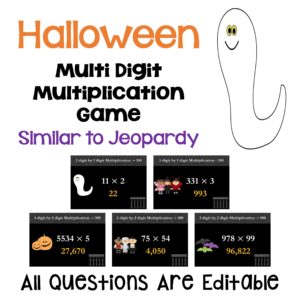
Halloween Multiplication GameOne of my favorite games to play in math class is a digital game similar to Jeopardy.  You can play it on any digital white board.  Assign teams then ask one member of the team to be the team leader.  This is the student who will chose the questions and communicate the group answer to you.  All of the students work on the questions independently then compare answers to make sure they have the correct one collaboratively.  I let other groups “steal” when the questions are not correct so that encourages everyone to work on all the questions.

Games can get a little loud so one trick I use is to call on the quietest team to pick their question.  It encourages them to keep the noise level down plus it allows me to manage the game so that all the teams have similar points.

5.  Holiday Resources

Holiday resources are great to use all year long.  Students get so excited about the clip art and fonts that they forget they are practicing multiplication.  It’s a great way to spiral multi digit multiplication throughout the school year.

If you need some easy, no prep holiday resources, here are a couple of my best selling multiplication resources with holiday themes.

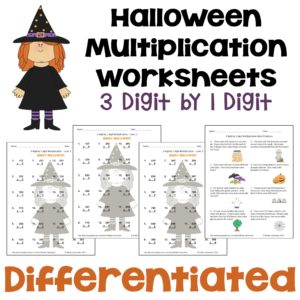
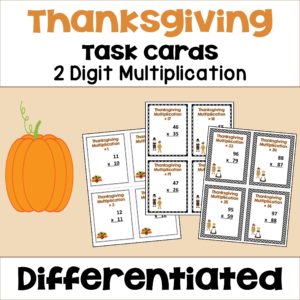
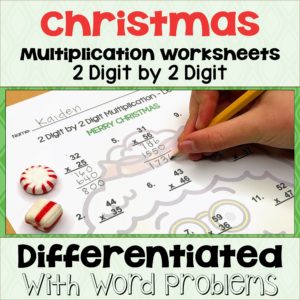
Halloween Multiplication Worksheets for 3 Digit by 1 Digit Multiplication     Thanksgiving 2 Digit Multiplication Task Cards     Christmas 2 digit by 2 digit Multiplication Worksheets

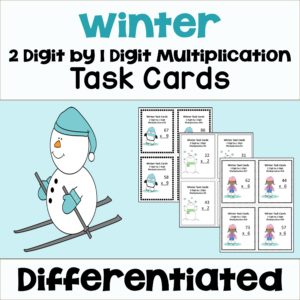
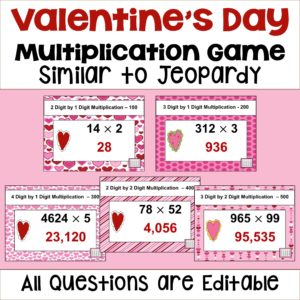
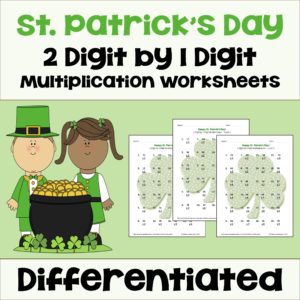
Winter 2 digit by 1 digit Multiplication Task Cards     Valentine's Day Multiplication Game     St. Patrick's Day Multiplication Worksheets

I hope you find all these suggestions helpful in Practicing Multi Digit Multiplication with your students.

Filed Under: 4th Grade Math, 5th Grade Math Tagged With: Multi Digit Multiplication, Multiplication, Practicing Multiplication, Teaching Multiplication

  • « Go to Previous Page
  • Page 1
  • Page 2

Primary Sidebar

About Me Image

I love helping teachers everywhere by providing quality resources and practical tips for the classroom. I know how stressful teaching can be and I'd love to make your job just a little easier.

All the best, Sheila

  • Email
  • Facebook
  • Instagram
  • Pinterest

Search

Recent Blog Posts

Infuse Magic & Merriment in Your Classroom with Christmas Bingo

A Christmas Multi-Digit Multiplication Bundle They’ll Love!

Thanksgiving Dinner Math Project – Based Learning for Grades 5-7

Free fraction worksheets

Free Fraction Worksheets

Footer

  • Email
  • Facebook
  • Instagram
  • Pinterest

© Sheila Cantonwine 2024 | Privacy Policy & Affiliate Disclaimer

Copyright © 2026 · Foodie Pro Theme on Genesis Framework · WordPress · Log in